
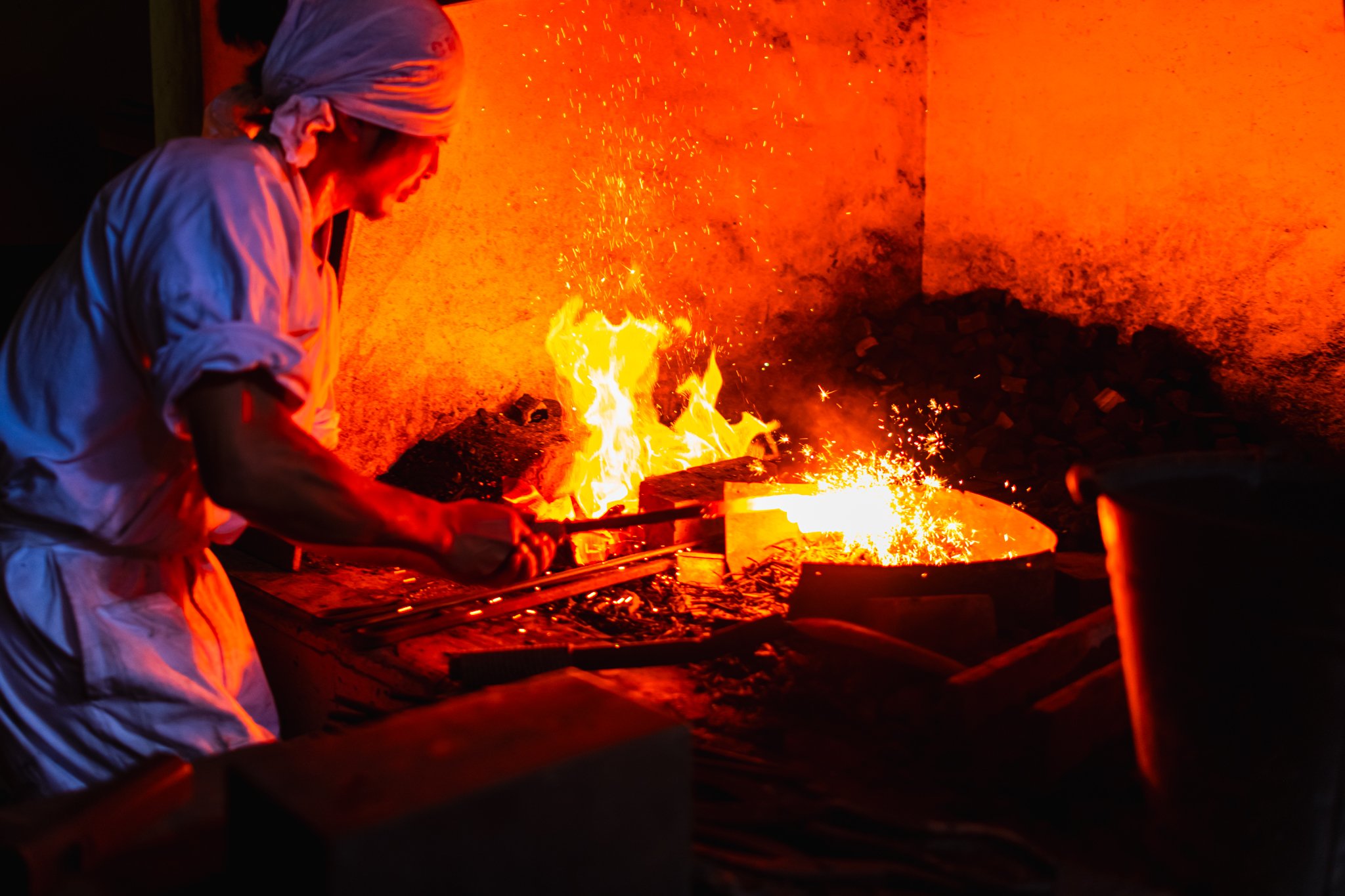
The Japanese katana is not made by a single craftsman. A swordsmith works the blade over months, heating tamahagane, folding the steel, and applying clay before the quench which sets the famous hamon into the blade. When the forging is done, the blade is still rough. A polisher, separately trained with their own apprenticeship, works it through graduated natural stones for weeks or longer. The hamon becomes clear through this process.
From there, the blade goes to mountmakers who fit the collar, shape the guard, wrap the handle, and build the scabbard. In a plain wooden Shirasaya, the blade is stored when it is not mounted for use, for example when its fittings are being repaired or the blade is resting between use.
Iaido sits separately from the making of the blade altogether. It is the martial discipline the blade was designed to serve: the practice of drawing and cutting in a single movement, developed across centuries through classical schools with their own lineages and grading systems.
This guide covers all four: forging, polishing, Shirasaya carving, and Iaido. Each requires a different specialist with a different training background. Most katana experiences in Japan available to travelers address one of these at the level of a short demonstration or workshop. This guide explains what each discipline actually involves, what the historical and craft context is, and what an authentic katana experience in Japan looks like at each level.
💡 Key Takeaways
A katana is made by at least two separately trained specialists. The swordsmith forges the blade and sets the hamon through quenching. The polisher reveals it: the temper line in a rough blade emerges through weeks or longer of work on sharpening stones.
Tamahagane, the steel used to make katanas, is produced from iron sand in a charcoal furnace over several days. Its uneven carbon distribution gives the blade a hard cutting edge over a more flexible body, a combination conventional steel does not replicate.
The Shirasaya is the plain wooden storage case for a blade, not a decorative scabbard. It is carved individually to fit one specific sword. Magnolia wood absorbs moisture without varnish, protecting the blade from rust during storage.
Iaido is not a stage in making the katana. It is the practice the blade was made for: drawing and cutting in a single movement. Reaching 7th dan requires decades of practice and examined understanding of the art's philosophy and history, not technical skill alone.
What Is Tamahagane? The Steel Behind the Sword
Understanding any katana experience starts with the material. Tamahagane is the steel traditionally used to produce Japanese swords. It is made from iron sand called satetsu, smelted in a charcoal furnace called a tatara over several days. The process produces a mass of steel with an uneven carbon distribution: some sections brittle, some ductile. The swordsmith separates these, forges and folds each section repeatedly, then combines them to produce a blade with a hard cutting edge over a more flexible body.
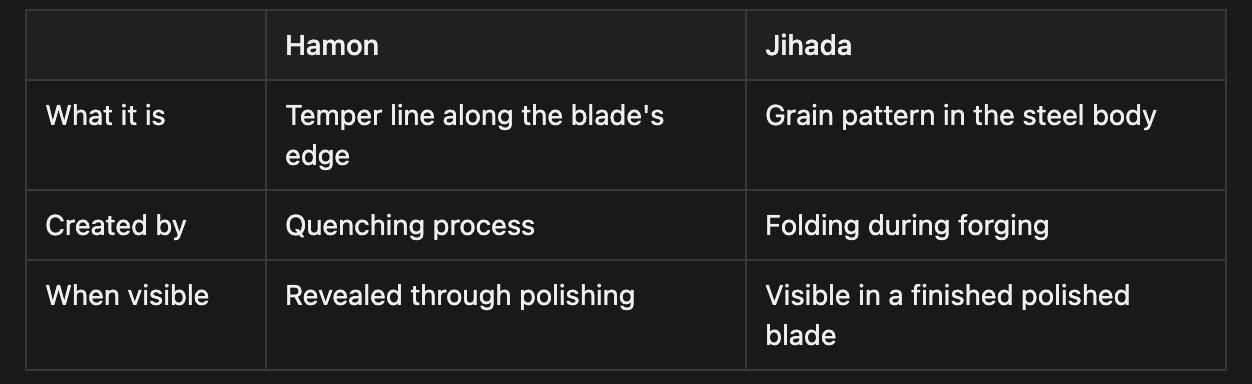
The hamon, or temper line, that appears along a finished blade is the visual record of the quenching process: the boundary between the harder martensitic edge and the softer steel in the body of the blade, revealed through polishing. It is not decorative. Different schools produce different hamon patterns, which is one of the ways lineage is read in a finished sword.
Schools are also identified by the grain structure visible in the folded steel, known as the jihada, which is created through the forging process rather than the quench. Different schools produce different jihada patterns alongside their distinctive hamon.
The Gassan school's signature is the ayasugi-hada: a cedar-wave grain pattern consistent across every generation of the lineage. Hamakawa Sensei, who leads our forging sessions, trained within this tradition for eight years under Gassan Sadatoshi, the fifth-generation representative, in Nara.
Katana Forging in Japan
Sword forging in Japan is not a single manufacturing step. It is the central discipline from which everything else follows. The swordsmith takes tamahagane, separates the high- and low-carbon sections, and works each through repeated heating and hammering to produce a blade that is hard at the edge and flexible in the body. Reading the colour of heated steel, managing angle and weight, timing the quench: this judgment takes years to develop.
Most katana experiences available to travellers are knife-making workshops, where participants shape a smaller piece of steel over a few hours. These are genuine introductions to working metal. They are not the same thing as a working day at a forge producing full-length blades within an established sword lineage.
The Gassan lineage
The oldest sword schools in Japan transmit their techniques not through texts but through direct instruction from master to student. The Gassan school is one of the most historically documented of these. It traces its origins to the old Gassan smiths of Dewa province, moved through the Osaka generations, and continues today in Nara. Its signature across every generation is the ayasugi-hada grain pattern.
The Osaka Gassan line produced Living National Treasure Gassan Sadaichi II. His son, Gassan Sadatoshi, the fifth-generation representative of the line, continues the tradition in Nara, where he accepted Hamakawa Sensei as a student for eight years of direct training to the standard of a house that regards its transmission as never broken.
The ayasugi-hada is not ornamental. It is the visual record of a specific forging technique passed from master to student through direct instruction across every generation of the school's history.
What a forging session involves
Hamakawa Sensei, the smith who leads our katana forging sessions, trained for eight years under Gassan Sadatoshi in Nara. He received approval from the Agency for Cultural Affairs to produce art swords in 2010, and won the Newcomer Prize at the New Japanese Swords and Swordsmith Crafts Exhibition. A blade of his is exhibited at the Kudoyama Sanada Museum in Wakayama. Sessions run a full day at an active forge. You operate the bellows, handle the hammer under the smith's guidance, and try the clay coating process. You leave with a piece of raw tamahagane.
Producing a finished blade takes weeks to months and passes through several specialist crafts beyond forging alone. The session is about understanding the craft and the techniques: what the steel does, why each step matters, and what the lineage behind it means.
Katana Polishing — The Art That Reveals the Blade
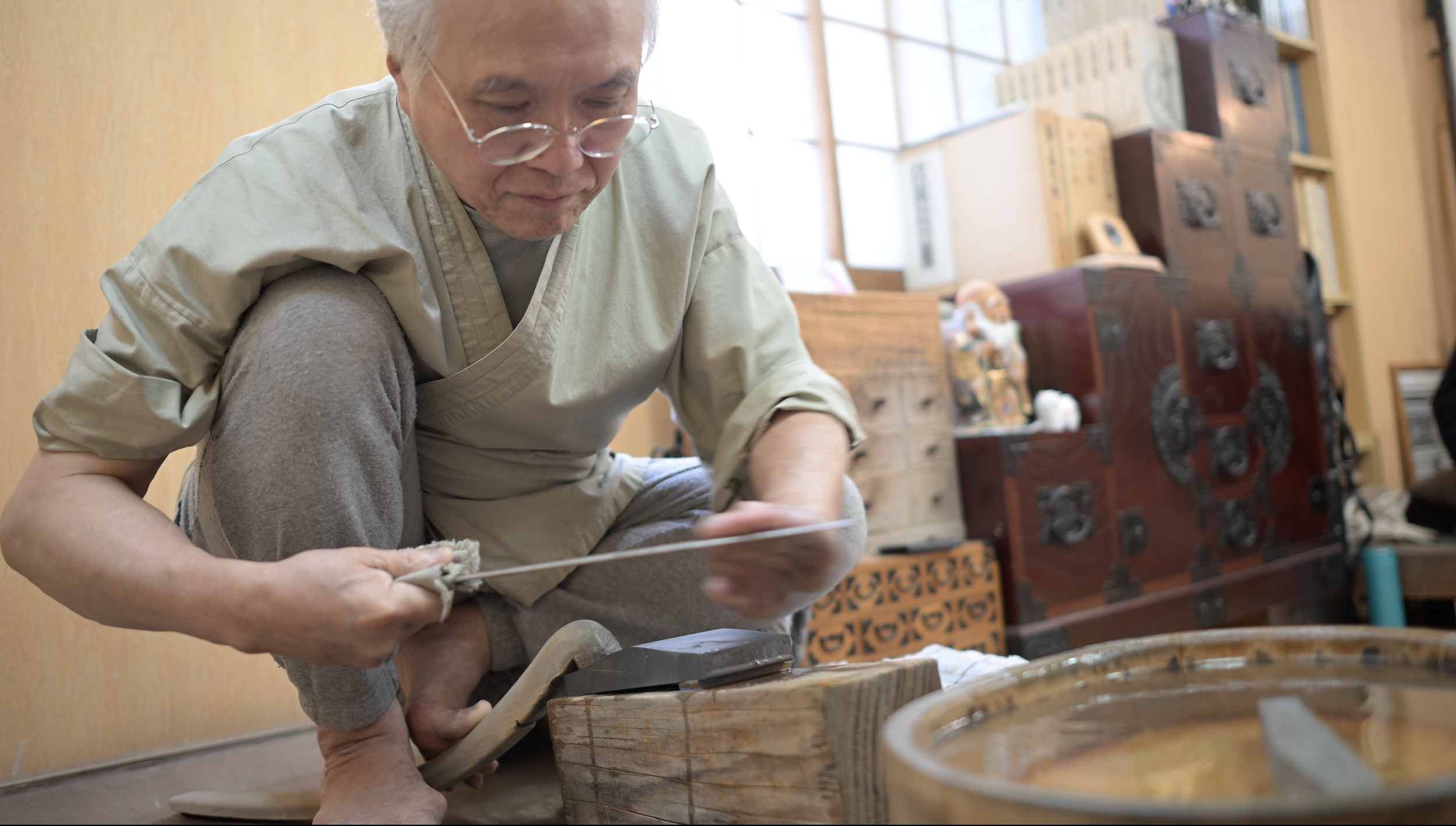
A forged blade is not a finished sword. Polishing is a separate discipline that can take hundreds of hours on a single blade. The polisher works through a graduated series of whetstones, reading the surface of the steel at each stage before deciding how to proceed.
A polishing error on a historically significant blade cannot be undone. This is why polishing as a craft and polishing as an appraisal skill develop together. The polisher needs to understand what the blade is, what period and lineage it represents, and what the surface is telling them at each stage.
Formal appraiser credentials in Japanese sword polishing are held by a small number of practitioners. Those who hold them have typically worked on blades of genuine historical significance, including pieces held by major shrines. Some attract students from outside Japan who travel specifically to study with them.
What a polishing session involves
Our katana polishing sessions are led by Manazu Sensei and run a full day in his private workshop. He opens by examining the blade in front of you: its shape, grain structure, hamon, and what each element records about how the blade was made. You then work alongside him through the early polishing stages on a blade he selects for the session, learning how the polisher reads the steel and how posture and angle affect the result. He demonstrates the later stages so you can see the progression and what the process reveals.
The work involves extended time sitting close to the floor with a forward lean. This posture is part of what the session teaches. Let us know in advance if you have lower back or mobility considerations.
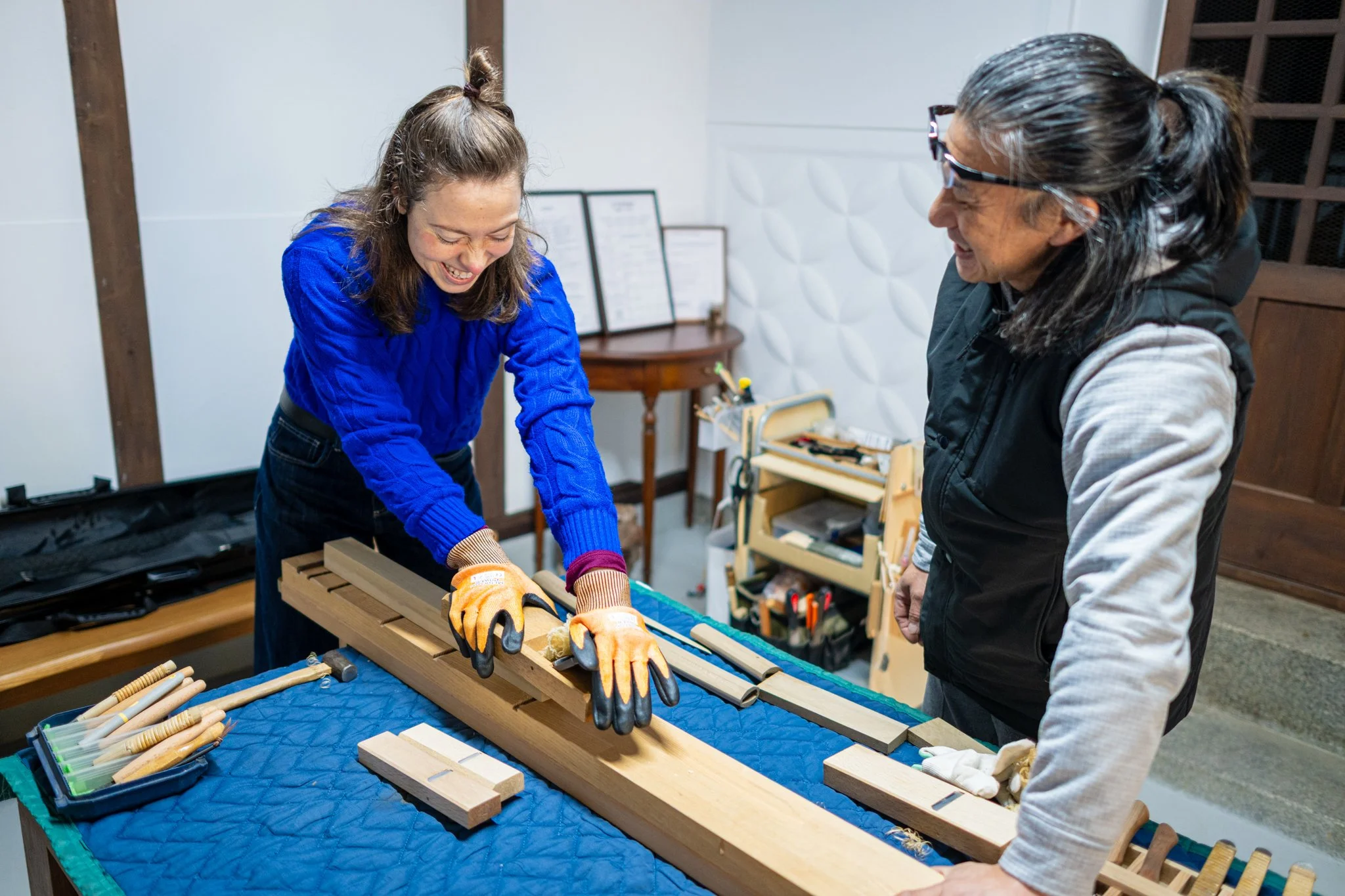
Shirasaya — The Blade's Resting Form
The Shirasaya is the plain wooden storage case in which a katana is kept when not in active use. It is not a decorative scabbard. It is a functional object: two pieces of magnolia wood carved to fit the exact dimensions of one specific blade, held without lacquer.
Magnolia wood is used deliberately. It absorbs moisture from the air without trapping it, protecting the blade from oxidation during storage. Lacquer would seal moisture in rather than allowing the wood to absorb it. Every blade in active preservation requires a Shirasaya, and the carver must work to the standard where the fit holds the sword securely without any contact that could damage the edge.
Shirasaya carvers work entirely by hand. The craft demands precision: not just physical technique, but the ability to read a blade's dimensions and translate them accurately into wood. Experienced makers are in high demand, because every blade in active preservation needs one.
What a Shirasaya session involves
Our Shirasaya carving sessions run approximately 2 hours and can be extended to a longer session. The master, Kitamura Sensei, comes from a professional background in Japanese joinery and trained into shirasaya carving through the Masumikai polishing community. He took First Prize in the Shirasaya category at the 2025 Exhibition of Contemporary Japanese Sword Crafts. He travels to lead the session at our location in Nara. You work from a real blade, tracing its exact dimensions into the wood and shaping the case by hand. He guides each stage: the initial trace, the hollow cuts, the test fits and adjustments. The standard applied is functional, not approximate.
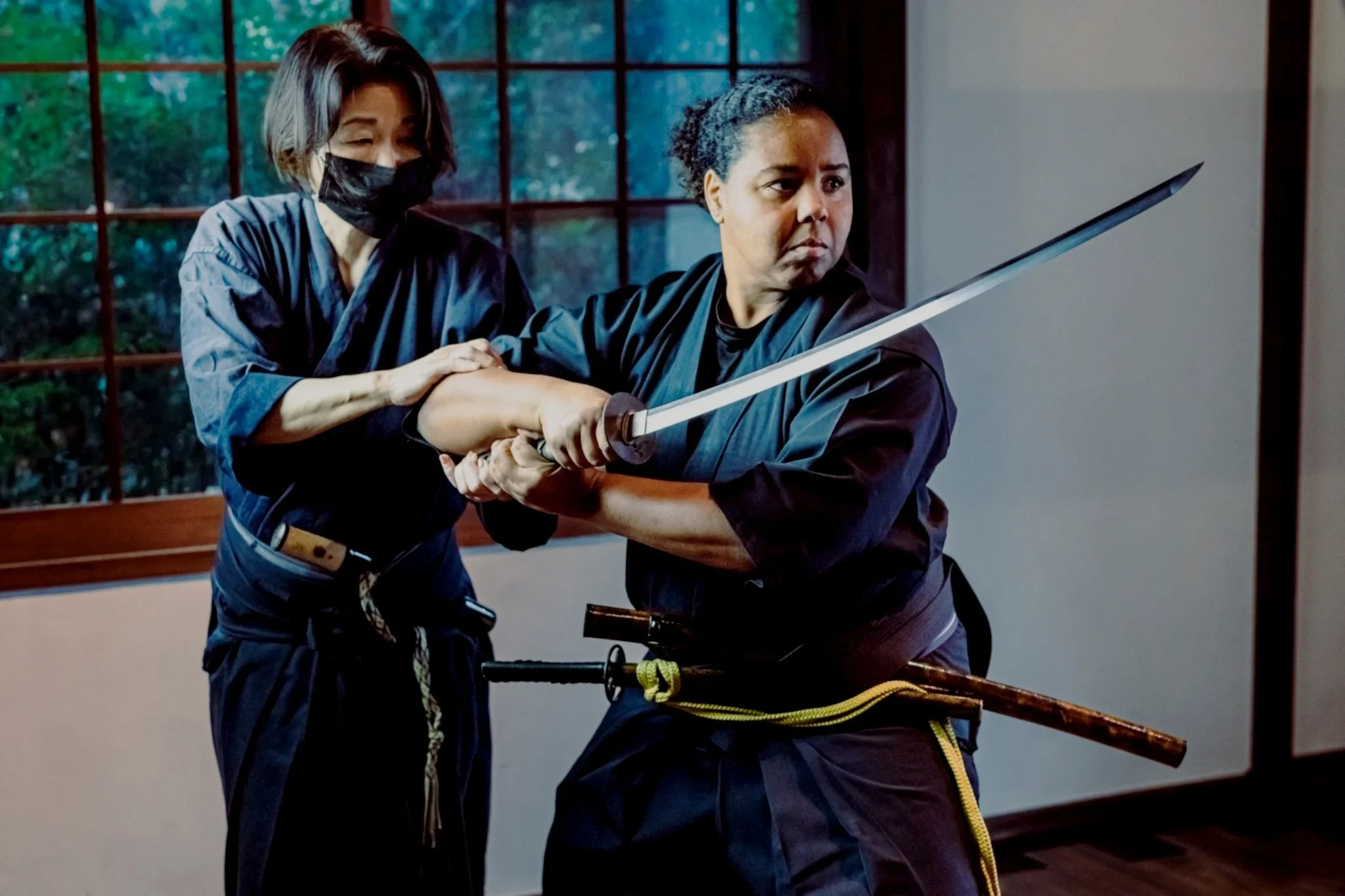
Iaido — The Practice the Blade Was Made For
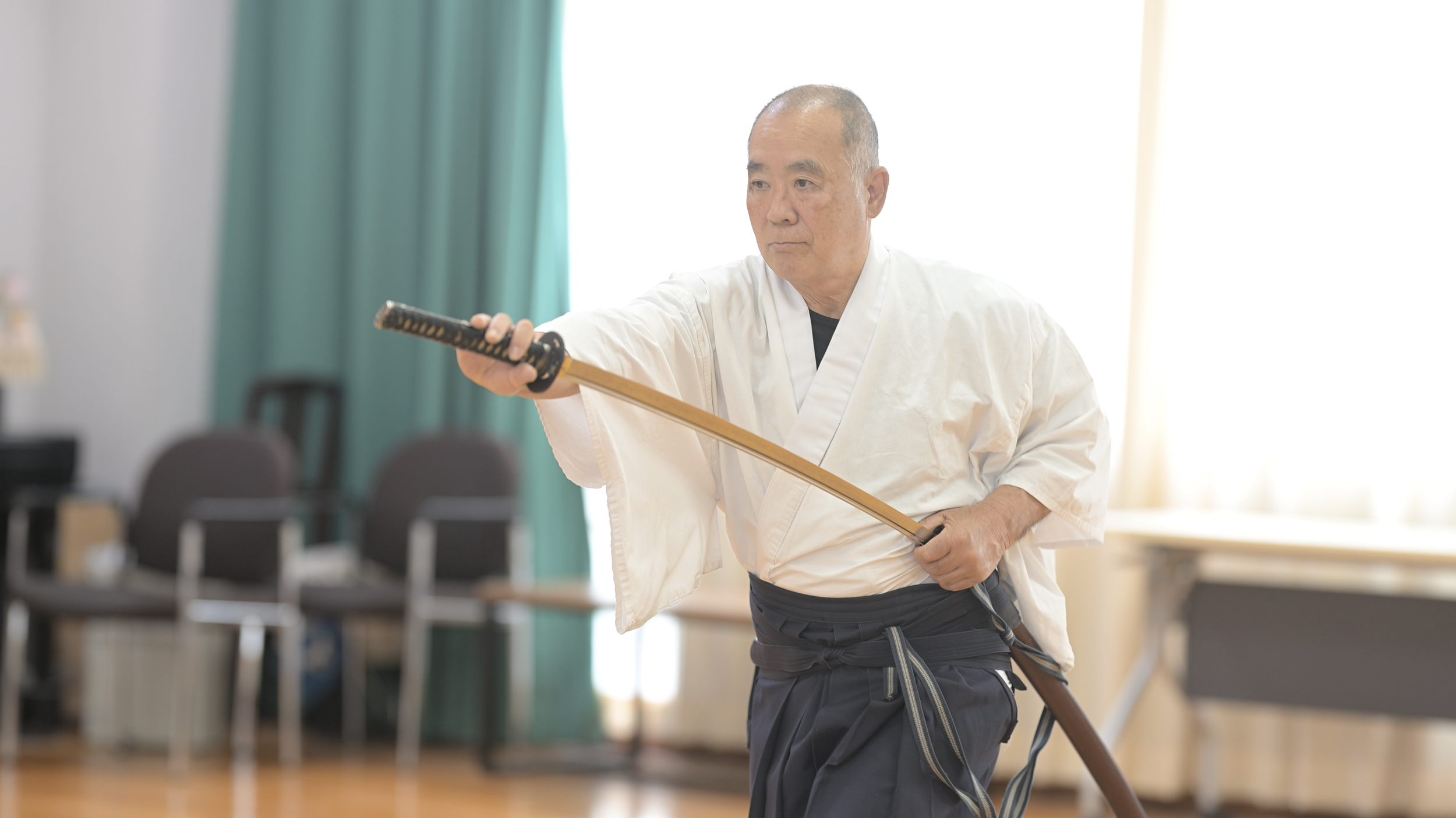
Iaido is the Japanese discipline of drawing the katana and cutting in a single controlled response to a sudden situation. The practitioner begins seated or in motion. The techniques, called kata, train the draw, the cut, and the return of the blade to the scabbard as one sequence: a practised response to a threat that leaves no time to plan.
Unlike kendo or kenjutsu, there is only an imaginary opponent. Iaido is practised through pre-set sequences developed and transmitted over centuries, each encoding a different scenario and response. The etiquette of the art, the sensitivity of early practice, and the emphasis on the blade's return to the scabbard all reflect that these are techniques developed with lethal application in mind.
What 7th Dan means
Iaido is graded through a dan system. Reaching the higher grades requires not just technical progression but examined understanding of the philosophy and history of the art. It is a distinction that reflects a lifetime of practice, not an accelerated certification track.
Yonekawa Sensei, who leads our Iaido sessions, received 7th dan in Muso Jikiden Eishin-ryu iaido, studying under Ikeda Sensei, the 22nd headmaster of that classical school. He also holds 7th dan in the Aikikai Foundation and chairs the Mie Aikikai Federation. He has taught at Aikido Manyo-juku in Imai-cho, Kashihara, Nara, a historic temple town recognised as a Japanese Heritage site, since 1983.
What an Iaido session involves
The master opens by explaining the origin and purpose of the art and the thinking encoded in the kata you will work on. You learn proper blade handling and the etiquette of the draw before any movement practice begins. The form you work on is accessible to beginners and complete in itself. The goal is to understand the thinking in the movement.

Experiencing These Disciplines in Japan
Kage Media arranges small-group sessions in all four disciplines, based out of Nara Prefecture.
The access to these masters comes from years of relationship-building in the region. Gassan Sadatoshi, the fifth-generation representative of the Osaka Gassan line and Hamakawa Sensei's teacher, is based in Nara. The polishing master, Manazu Sensei, is a member of the Society for the Preservation of Japanese Art Swords and has worked on blades of significant cultural weight, including temple and shrine treasure swords. He has students from outside Japan who travel to study with him. Yonekawa Sensei, who leads the Iaido sessions, holds 7th dan in both Muso Jikiden Eishin-ryu iaido and the Aikikai Foundation, and has taught at a heritage-listed site in Nara since 1983.
Each session is a full working day or a substantive half-day alongside a practitioner who has spent most of their adult life in the craft. The access is the result of years of relationship-building in the region.
If your interest in Japanese sword culture goes beyond a single session, a programme across several days can cover all four experiences alongside historical and cultural sites. Get in touch with your travel dates and what draws you, and we will work out what is possible.
Practical Details: How to Book and What to Expect
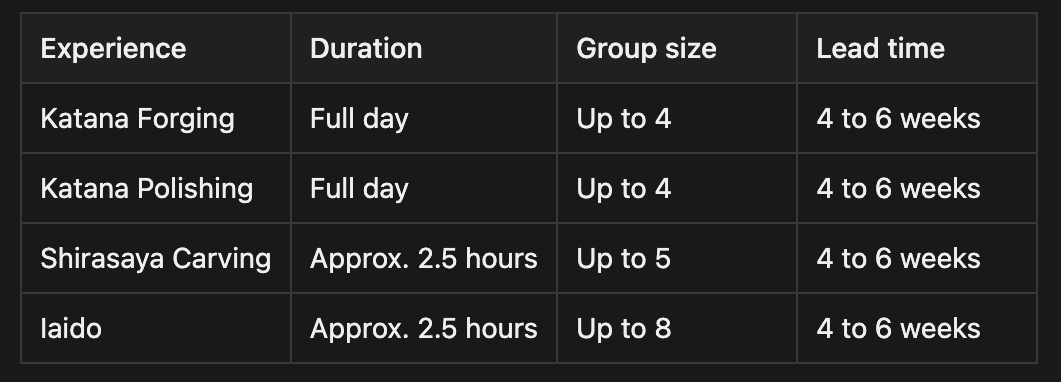
All sessions operate on a 4 to 6 week lead time. Book as far ahead as your travel dates allow. If you are visiting during spring (late March to May) or autumn (October to November), earlier is better.
How to book: Contact us at kage.media/contact with a note on which sessions interest you and your travel dates. Every inquiry is read and answered personally.
Combining sessions: The Shirasaya and Iaido sessions can be combined in a single day. Forging and polishing are each full-day commitments and work best as standalone days. If you are combining any session with Nara city sightseeing, the Iaido session fits best: it finishes within the afternoon and leaves time for Todaiji, the deer park, or Naramachi.
Getting there: Shirasaya takes place at a prepared space in Sakurai, Nara Prefecture. Iaido takes place at a private dojo in Imai-cho, Kashihara, Nara, a historic temple town. For forging and polishing, directions to each workshop are sent on booking. For sessions outside Nara, customers arrange their own transport.
What to wear: For forging, wear clothes you do not mind getting dirty and that cover exposed skin. Synthetic fibres near the forge are not recommended. Bring your own water. For polishing and Iaido, comfortable clothing that allows low floor-level movement is best.
Frequently Asked Questions
What is tamahagane?
Tamahagane is the traditional steel used to produce Japanese swords. It is made from iron sand smelted in a charcoal furnace called a tatara over several days. The process produces steel with a distinctive combination of hardness and flexibility that conventional modern steel does not replicate. The grain structure it creates is visible in a finished polished blade and is one of the primary ways experts read the quality and lineage of a sword.
What is a hamon?
The hamon is the temper line that runs along the edge of a finished katana. It is the boundary between the harder martensitic edge, produced by the quenching process, and the softer steel in the body of the blade. It emerges through polishing. Each school produces a different hamon pattern, which is how lineage and tradition are read in a finished sword.
What is a shirasaya?
The Shirasaya is the plain wooden storage case for a blade. It is carved from magnolia wood to fit the exact dimensions of one specific sword, protecting it from moisture and oxidation during storage. Plain wood is used deliberately: varnish would seal in moisture rather than allow the wood to absorb it. The Shirasaya is the resting place of the blade.
What is the Gassan school?
The Gassan school is one of Japan's most historically significant sword lineages, tracing its origins to the old Gassan smiths of Dewa province. The line moved through the Osaka generations and continues today in Nara. Its signature is the ayasugi-hada: a cedar-wave grain pattern created through a specific forging technique. The Osaka Gassan line produced Living National Treasure Gassan Sadaichi II, and his son Gassan Sadatoshi, the fifth-generation representative, continues the tradition in Nara.
What does a 7th Dan Iaido ranking mean?
Iaido dan grades reflect not just technical proficiency but depth of understanding of the art's philosophy and history. Reaching 7th dan requires decades of continuous practice and is earned over a lifetime, not through an accelerated track. Yonekawa Sensei, who leads our Iaido sessions, holds 7th dan in both Muso Jikiden Eishin-ryu iaido and the Aikikai Foundation, and has taught continuously since 1983.
What does the katana forging session at Kage Media involve?
A full day at an active forge producing full-length blades, led by a smith trained within the Gassan lineage. You operate the bellows, handle the hammer under the smith's guidance, observe the clay coating and quench, and leave with a piece of raw tamahagane. The focus is on understanding the craft and the techniques: what the steel does, why each step matters, and what the lineage behind it means.
Can a complete beginner do these experiences?
Yes. All four sessions are designed for people with no prior knowledge of sword-making or martial arts. Practical notes by session: forging involves physical activity and heat from the forge. Polishing involves extended time in a low, forward-leaning posture. Iaido involves floor-level work. None require particular fitness or prior experience.
How far in advance do I need to book a katana experience in Japan?
4 to 6 weeks minimum for confirmed availability. If you are visiting during a peak season, book before you finalise your flights. The masters we work with are active practitioners, not full-time hosts, and their availability is genuinely limited.
Can I do more than one session during a single trip?
Yes. Shirasaya and Iaido can be combined in a single day in Nara. A two-day visit covers Iaido, Shirasaya, and one of the full-day experiences. For all four, three days is the practical minimum, with different travel days for forging and polishing. If you are basing yourself in Nara, historical sites including Oomiwa Jinja and Asuka are nearby.
Kage Media is a licensed travel company based in Nara Prefecture. We arrange small-group cultural and craft experiences with masters in katana forging, polishing, Shirasaya carving and Iaido. Get in touch with your travel dates to discuss availability.