
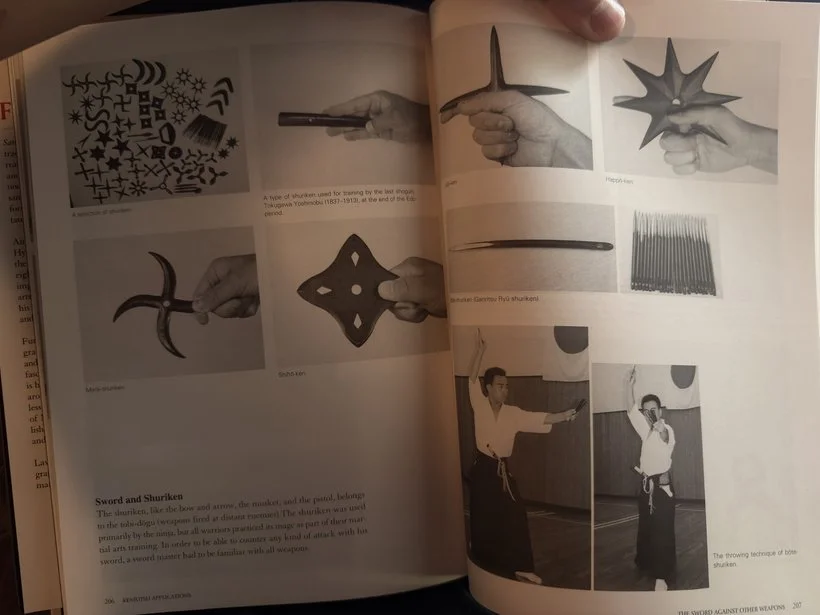
Bo-shuriken are straight, stick or spike-like throwing weapons from samurai traditions. Though most people think of them as being ninja weapons, bo-shuriken were considered standard equipment, used for distractions (often thrown directly at the enemy) and emergencies, often hidden as topknot pins.
It became a standard part of comprehensive bujutsu (martial arts) training in the Edo period (1603–1868).
Unlike the famous star-shaped hira-shuriken, bo-shuriken are typically 12-21 cm long, weighing 35-150 grams, and come in shapes similar to everyday items like nails, chopsticks, and needles. Throwing them is quite difficult, requiring sensitivity in body mechanics, grip, and timing--not to mention extensive practice.
I've included video, skill tips, and descriptions in this article.
Disclaimer: I'm still a student, so take these tips with a grain of salt.
1. Grip and Stance
It's easier to start close to your target (3 meters) to build muscle memory, but not so close that a mistake can bounce the shuriken back to you in a dangerous way. Jiki Da-Ho is the "Direct-Hit Method."
This is a no-spin technique for straight, point-first penetration, and these tips are relevant to this technique.
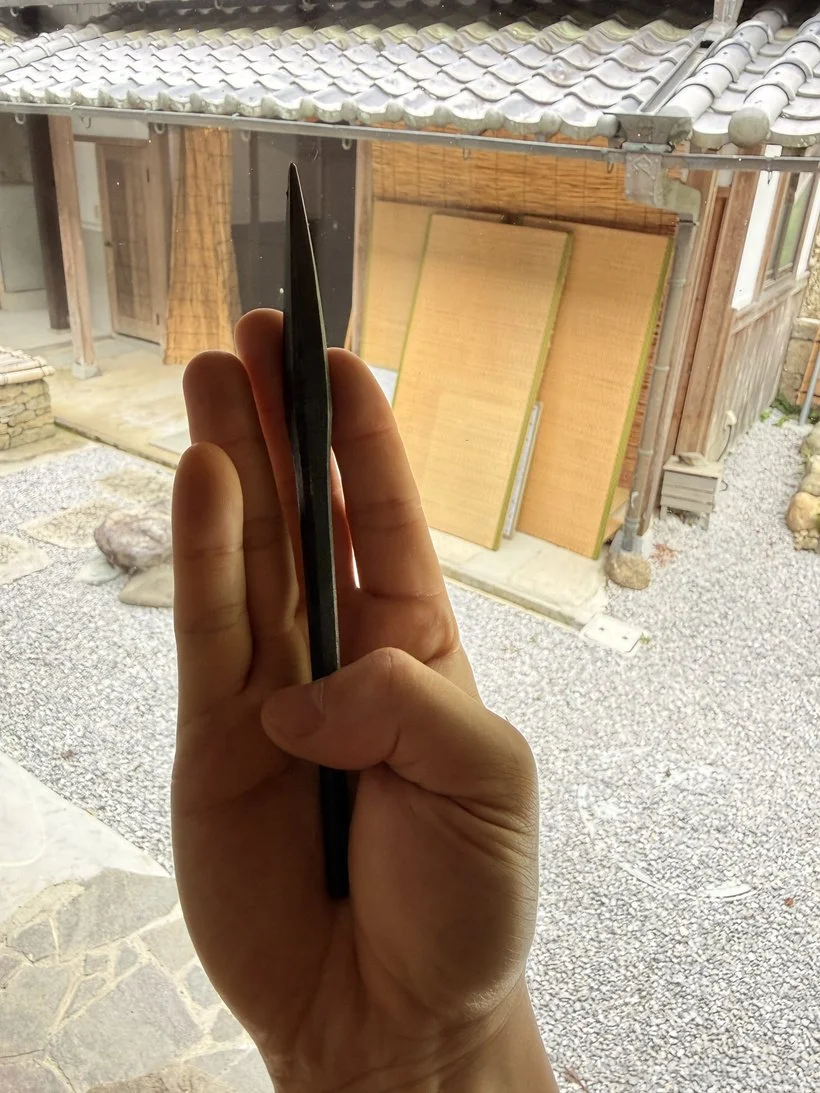
Grip: Hold the bo-shuriken between your index and middle fingers. If you have a thicker one, the ring finger can also be used. Use your thumb to lightly lock the shuriken to your palm; hold firm but relaxed. When you throw, it'll slide smoothly out of your hand. I think about it like you are forming a relatively fixed "barrel" that the shuriken will slide out from as you throw, rather than anything you truly manipulate with the fingertips. A pinch grip (thumb and index finger only) is much more difficult, in my opinion.
Stance: Stand with feet shoulder-width apart, knees slightly bent for balance. Your non-throwing hand can hold additional shuriken. A 60% from front facing was ideal, though others have various opinions. Either way, start with the weight in the back leg. Sink your knees slightly and be ready to engage your core and hips which is important for power.
2. The Throwing Motion
Traditional throws mimic natural strikes, like a chopping hand motion in various martial arts. However, unlike the chopping hand, the wrist may turn a little forward to make sure the motion is straight. The wrist will also be slightly relaxed to find the normal pace of a smooth throw. That said, on beginning tried, I recommend keeping the wrist cocked back, more rigidly, until you become more familiar with the throw. Focus on a fluid, controlled release where the shuriken glides through your fingers.
In detail, draw your arm back at a 45-degree angle, wrist cocked. Shift forward while whipping your arm into extension while keeping it relaxed, do NOT snap the wrist down. For closer targets, try not to lean too far forward, keeping the back mostly straight. Release when your arm is slightly above parallel to the ground, letting the shuriken slide out without rotation.
Tips:
The throw feels "late" when considering rocking your weight from back to front leg.
Extending the push phase of the throw can increase accuracy, meaning that your elbow slightly moves into more extension than a normal chopping motion. Originally, however, I was taught to mostly lock the elbow and focus on shoulder extension (anatomical movement, please double check your understanding).
Cock the wrist back a little, even a lot, and leave it mostly there. A relaxed wrist will smoothly adjust slightly throughout the throw phase, but it's a lot more wrist back into extension than you'd imagine.
A visual to get started is almost like you're hitting someone's upper back in front of you with the heel of your hand. At first, there's something of a stopping feel, like you're trying to halt your swing just at the right moment, but as your timing improves, that smooths out.
Do not do a big baseball pitch motion. Keep things tight and short at first, and mostly relax. I started and still am relatively stiff, but it's become easier and easier over time.
FEEL the shuriken's weight. Even practicing a lot, every placement in your palm is slightly different. You need to feel the shuriken's particular position before you throw it, since the ultimate goal is to be able to throw basically anything from any angle at any time. While it becomes mostly instinctive, intentionally feeling is a major part of skill improvement.
Don't change technique too much. It takes time to master, so adding one adjustment at a time for an extended time is not only necessary for improvement, but for concrete data to see if it improves your technique. I can't tell you how often I thought that my newest slight adjustment to technique was "the answer" that would solve all other answers, only for it to start failing several throws later.
You'll discover so many minor adjustments as you practice that can't really be explained without practice. Just time and effort teaches you the fastest.
Focus on the target, in the same spot, every time. You can adjust your throw much better over time if you keep that spot consistent.
Throw starting with your hand slightly higher than you'd expect, a bit overhead at first. Most people tend to throw too low at first and over-rotate.
I found that the straight swing, how I was taught, was incredibly hard to do when combine with a small torso turn and weight shift. At some point, I started to allow my swing to cross my body a little, and it felt a lot more fluid, and when I reviewed it with a torso twist and weight shift, my arm swing seemed a lot straighter in path--and the shuriken's path--as well.
Holding the shuriken's center of mass closer to the fingertips than you may expect will make it easier to control. If your shuriken is short, then it can be difficult, but by having the shuriken's center of mass closer to the fingertips, poor technique or accidental pushes with your fingertips will rotate it less and give you more consistency in your throw.
Account for drop-over-distance—shuriken arc slightly, so aim higher for farther throws. Traditional ranges are 3-7 meters for effectiveness. For distant ones, release earlier with more hip drive and forward lean. Traditional ranges are 3-7 meters for effectiveness.
Over time, your eye will develop so you'll be able to watch the throw path. One of the hardest parts of throwing bo shuriken is that it is extremely easy to add other vectors of rotation to the shuriken unintentionally, which makes it much easier to not stick, slapping against the wall instead.
Feeling the slide as you release the shuriken, where your fingertips are almost brushing/blocking the shuriken's rotation from continuing on release, which is a "sweet spot" of speed and soft release. This makes it so that that there's a high probability that the bo shuriken is pointed forward on impact.
The shuriken you train with matters a lot. Having angles and flat sides on the shuriken, rather than just a rounded surface, helps a lot. Also, you'll understand why traditional shuriken have a particular shape where weight and thickest parts are slightly to the front pretty quickly after you practice.
And that's it for now. I hope you enjoyed this post.
You can see how the weight of the shuriken pushed to one side effects the ease of throw by reducing the likelihood of rotation, easier control with the angled flat edges, and easier penetration with the tip weighted.
If you're consider purchasing bo-shuriken, please reach out. We may be able to offer handmade, authentic bo-shuriken forged by a master katana kaji (swordsmith). Choose from iron models perfect for dedicated practitioners seeking quality without compromise, or, elevate to premium tamahagane versions, crafted from the same legendary steel of Japanese swords. This unique combination of tamahagane bo-shuriken is virtually non-existent anywhere else. These are rare a rare blend of historical craftsmanship, with superior balance and edge retention, and unavailable in mass-produced alternatives. Keep in mind that these cannot be exported sharpened due to regulations on weapon exports, and must be labelled as a martial arts training or replica collectables and may be turned away by your jurisdiction.
The official description is as follows:
Traditional Japanese Bo Shuriken Historical Replica (Unsharpened / Blunt)
Forged using traditional Japanese techniques from Tamahagane steel / iron by a licensed Katana Kaji (swordsmith).
This is a non-functional decorative and collectible item intended solely for display, collection, cultural/historical study, education, or theatrical prop use.
It is unsharpened/blunt and not designed, intended, or suitable for use as a weapon, throwing implement, combat tool, or for any harmful purpose.
Not a weapon. Buyer is solely responsible for compliance with all applicable import, possession, and local laws in the destination country.
Japanese version (for domestic/docs): 「伝統的な日本製 棒手裏剣 歴史的レプリカ(未研ぎ・鈍角仕様)
刀鍛冶(かたなかじ)による伝統技法で鍛造された玉鋼 / 鉄製。
本製品は装飾・収集・文化研究・教育・演劇用小道具専用の非機能的レプリカです。
未研ぎ・鈍角仕様で、武器・投擲具・戦闘用具としての使用を目的・設計・適合していません。
武器ではありません。購入者は仕向国の法令遵守に全責任を負います。」
Disclaimer: Due to varying international regulations on weapons and replicas, shipping bo-shuriken may face restrictions or delays in certain countries. Buyers are responsible for verifying local laws and import requirements before ordering. Purchases are accepted via bank transfer and USDC crypto transfers only, and will require full KYC to be accepted. Note that all purchases are defined as collectable items only.
Finally, please note that as these are hand forged, it may take up to a couple weeks to craft based on demand and availability.